
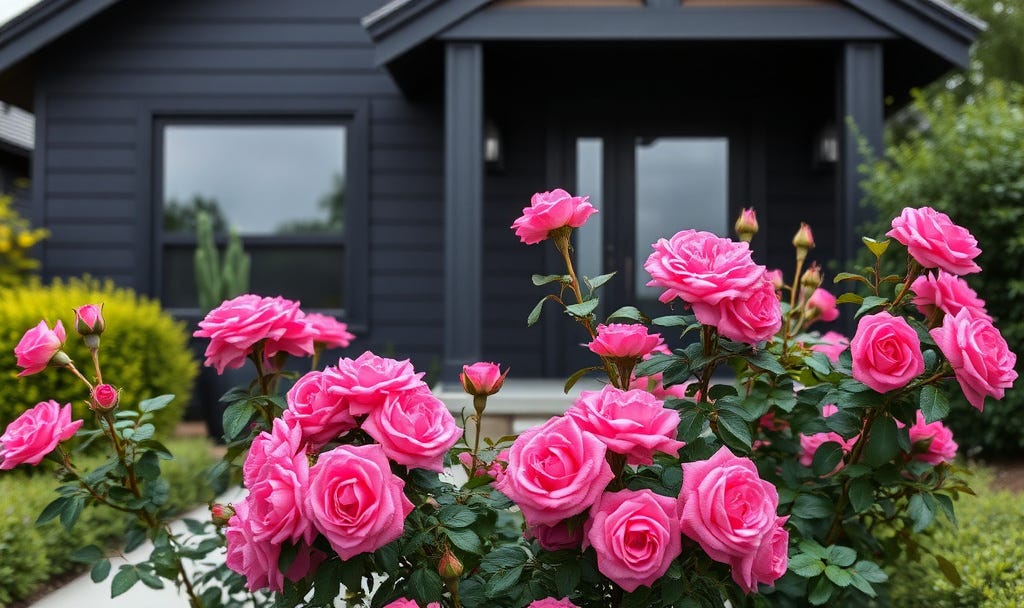
Showy Knockout roses flanked the entrance to our prospective home when we arrived for a tour in August 2024. Near the end of their growing season, the dappled pink flowers insisted on dazzling potential buyers despite the oppressive summer heat.
The Neil Sperry devotee who resided in the house before us considered these bushes a good idea. They couldn’t fool me. My plant skills may be middle-of-the-road, but I knew enough to see them for what they really were: high maintenance.
Roses are anything but a “set and forget” plant.
We moved into the house the following month. The hot pink buds wilted, then shed to the ground, leaving behind pale green triangles with crispy brown edges. If I squinted, they bore a slight resemblance to the terrorizing creatures in Stranger Things. Or maybe that was my Rorschach-style interpretation.
I spent time that winter educating myself on the pruning they would need in the spring. I refused to let my preconceived notions about the plant dissuade me from their proper care.
The roses were fortunate for this reason. I am a plant lover through and through. I’ve lost count of the number of houseplants we own, much to the chagrin of my husband. It’s akin to “chicken math” in the form of propagation.
Gratitude and resentment can live in the same garden.
President’s Day, the apparent marker for many rose horticulturists, came and went. I worried I’d waited too long for a proper haircut when the bushes sprouted new growth, but in early March, I armed myself with shiny new pruning shears and a paper lawn bag.
I set to work, following the guidance I’d learned from YouTube experts: trim anything smaller than a pencil, cut out the bull canes (stalks that have turned to wood), and sever anything that doesn’t support the vase-like shape.
When I finished the task, I was certain I’d butchered them beyond hope. They looked correct, as sparse and spindly as many of the educational videos I watched. As a plant lover, however, it felt cruel to remove thousands of tiny leaves edging their way to new life.
Within weeks, the bushes were thriving, as if I’d never trimmed a stem. By April, the buds were emerging, ready to explode with pink pom-poms. By summer, the green foliage practically disappeared beneath a fuschia flower blanket.
The tedious task of pruning was behind me. The thorny stabs and meticulous shaping, hours spent perfecting the plants, all disappeared with the end result. My resentment took a backseat to pride as the bushes graced us with iconic Texas landscaping beauty.
The roses even gifted me with stress-relief one day as I learned the gratification of dead-heading. Taking the pruners to each spent bloom, my worries fell to the ground like the withered flower I was removing. It reminded me of the cathartic nature of bubble wrap.
We’d left the driveway bushes alone, curious to see what would happen left untended. They operated similarly to the others, bursting with new leaves and flourishing with buds, but they didn’t seem to repeat their blooms like the pruned ones did, despite deadheading. It was a “one and done” explosion of color.
I didn’t hate the roses. I hated pretending.
I took note of President’s Day this year, mentally preparing myself for this obligatory annual ritual. In total, we have eleven Knock Out rose bushes, which I hoped I could knock out in one weekend. The unseasonably warm February was spurring new growth alongside the demagorgons. The bushes at the driveway entrance were unruly thanks to our experiment in neglect last year, overrun with neighboring pasture grass and wayward Mesquite saplings.
I’d studied the growth patterns last year and became concerned we were victims of RRD, Rose Rosette Disease. It is a fatal virus that results in an overgrowth of thorns, among other symptoms. My bias against the roses secretly rooted for this to be the case, as immediate removal is the only solution.

Before this year’s haircut, I sent photos to a Master Gardener friend. The dense thorns, another demonic attribute for a seemingly-innocent plant, were suspicious, she concurred, but alas, she did not think the plants were RRD victims. She suggested we keep an eye on new growth for more obvious signs, thwarting my campaign to replace them with red yucca.
The thorns were especially troubling this year. In addition, the unchecked growth of our experimental “feral” bushes had staked claim on several inches of airspace through the welded wire fence.
I was equally as ruthless, cutting out entire canes and pruning to the point of dulled shears. My husband continually suggested he could take the hedge clippers to them. The perfectionist in me insisted on following the rules of engagement as recommended by several rose experts.
I tried crafting an analogy in my head as I trimmed.
The thorns could represent hardships in life, the difficulties hidden behind the beauty of a bloom.
I’m cutting away an old life to make room for new growth, having left a lucrative corporate career and reluctantly closing my yoga studio.
My life coach uses the word ‘pruning’ often for the myriad pursuits I’m exploring in the spirit of creative entrepreneurship.
Thoughts swirled, but all life lessons were lost on me.
Only one thought permeated my brain.
I hate roses.
The idea felt scandalous. Roses are the floral world’s version of America’s Sweetheart. There is an entire parade dedicated to their beauty. They are a symbol of love and romance. And I don’t hate love and romance…do I?
All I know is that by the time I got to the last cluster of bushes, I followed my husband’s advice. Wielding the hedge clippers, I hacked the tops of the shrubs off like a crazed Edward Scissorhands.
At 50, I’m finally living my truth. I could no longer tolerate pointless negotiations in the retail world, and I can no longer tolerate maintenance of plants that inflict pain. In a nod to my former Director role, I’m delegating this job to my husband next year.
I’ll take my roses safely arranged in a vase, thank you.